
Video is the king content in 2026. Your prospect consumes 100 minutes of video content every day, but only 15 minutes of text content. If your competition produces 10 videos per month and you produce 2, you are far behind. A video marketing strategy provides direction. It aligns your video production with your real business goals: generate qualified leads, increase your sales, strengthen customer loyalty, dominate your niche.
Without a strategy, you produce for the sake of producing. With a strategy, you produce to convert. The delta is huge. According to The HubSpot State of Marketing report, businesses with a clear video strategy increase their conversion rate by 80% and reduce their acquisition cost by 45%. They also generate 10 times more qualified leads than before. This is because a cheap video that is misplaced does not convert anything, while a well-thought-out, well-placed video, broadcast at the right time in the prospect's buying journey, creates an immediate reaction.
Kosmos, video agency in Bordeaux, builds with its customers a video marketing strategy that structures the entire year: what to produce each month, how to deploy each video on 8 different channels, how to measure each click and each conversion. It's not magic, it's methodical. And that's what makes the difference between a video agency and a video agency that generates real business.
- Video consumption: 100 minutes of video per day vs 15 minutes of text, video takes precedence over all content
- Increase in conversion: +80% with a clear video strategy compared to no strategy
- Reduction in purchase costs: -45% in customer acquisition costs with a structured video funnel
- Qualified leads: 10x more leads with a video strategy than without
- Video lifespan: A well-optimized YouTube video generates traffic for 2 to 3 years
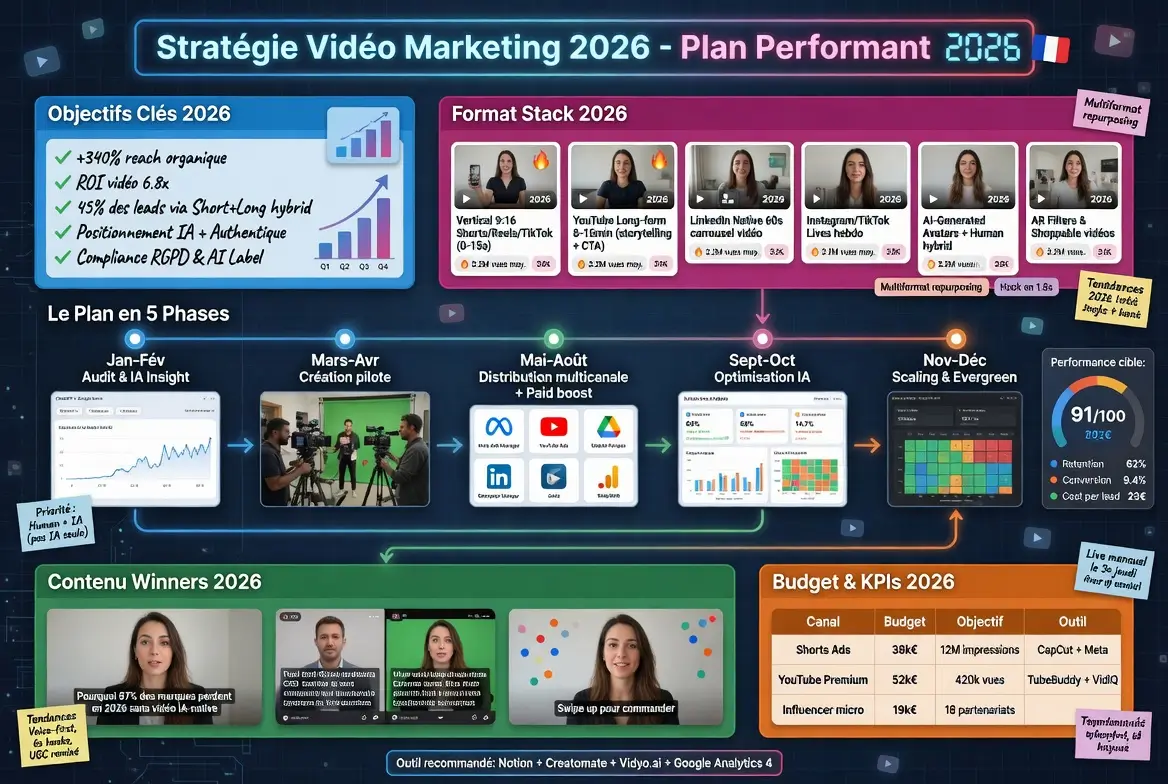
Step 1: Define your clear video goals
Every video marketing strategy starts with a question: what should your video do? There are four typical goals, and you'll target one, two, or three depending on your business maturity. Each objective implies a different video type, channel, duration, and KPI.
The “Awareness” objective: promote your brand, attract raw traffic, increase your visibility. You are targeting large audiences, not yet familiar with you. The formats: short brand videos (15 to 60 seconds), educational videos that answer a broad question (how to optimize your time? how to choose a supplier?) , trending videos on TikTok and Reels. The KPI: number of views, reach, impressions. No conversions yet, just awareness.
The “Consideration” objective: to make your prospect go from “I know him” to “I consider him”. He saw you, now he must understand that you are the solution to his problem. The formats: in-depth tutorials (3 to 8 minutes), webinars, animated explainers, solution comparisons. The KPI: engagement (comments, shares, clicks to more info), time spent on the video.
The “Conversion” objective: to transform a prospect into a customer. It is the heart of the funnel. The formats: testimonial videos (how you solved a customer problem), product demonstration videos, case studies. The channel: your sales pages, landing pages, emails, LinkedIn. The KPI: clicks to the quote, form submissions, direct purchases.
The “Loyalty” objective: to transform a customer into a recurring customer, then into an ambassador. The formats: exclusive content videos for customers (advanced tutorials), VIP webinars, new feature videos. The KPI: retention rate, resale rate, sharing testimonies.
- Awareness: brand video, broad educational content, TikTok/reels, KPIs = views and reach
- Consideration: tutorials, webinars, comparisons, KPIs = engagement and watch time
- Conversion: testimonials, product demo, use cases, KPI = leads and sales
- Loyalty: exclusive content, advanced tutorials, VIP webinars, KPI = retention and recommendation
Step 2: choose your video formats according to your objective
A video format is the content (what you say) + the form (how you say it) + the duration. For every purpose, some formats convert better than others. Knowing the format x objective matrix allows you to allocate your video budget effectively.
For Awareness, short formats dominate: 15 to 60 second clips, trending TikTok videos, YouTube shorts, Instagram Reels. The aim is virality, sharing, the accumulation of raw views. In consideration, you are lengthening: 4 to 8 minute tutorials, expert interviews, comparisons (your service vs traditional method). These formats keep the prospect longer and create perceived value. In conversion, return to precision: testimonies of 2 to 3 minutes, product demos of 60 to 90 seconds, case studies of 5 minutes. The tone is changing: less entertainment, more proof and more encrypted ROI. In loyalty, rich content for existing customers: live webinars (45 to 60 minutes), advanced tutorials (8 to 15 minutes), behind-the-scenes.
Step 3: Map your annual video calendar
A video marketing strategy without a calendar is still an intention. Create a 12-month plan: how many videos to produce each month, what type (Awareness, Consideration, Conversion, Loyalty), what main channel. Ideally, aim for 2 to 4 videos per week: 8 to 16 videos per month. If that's too much, start with 4 videos per month (one per week), then work up your pace.
A good annual distribution: 40% Awareness (building the brand, generating raw traffic), 35% Consideration (educating your prospects), 20% Conversion (converting into customers), 5% Loyalty (keeping your customers). This distribution creates a balanced funnel. If you focus too much on Conversion, you're not generating enough raw leads. If you lean too much into Awareness, you generate traffic but not sales.
Also cut by channel. YouTube should receive 40% of your video budget (long-form content that generates sustainable SEO traffic). Tiktok/reels 30% (Awareness and virality). LinkedIn 20% (B2B and consideration). Instagram Stories 10% (customer engagement and loyalty). This distribution varies according to your sector: a tech B2B involves 60% LinkedIn, 30% YouTube, 10% others. An e-commerce brand goes 50% TikTok/Reels, 30% YouTube, 20% others.
- Target volume: 8 to 16 videos per month, or 2 to 4 per week
- Objective distribution: 40% Awareness, 35% Consideration, 20% Conversion, 5% Loyalty
- Channel distribution: 40% YouTube, 30% TikTok/Reels, 20% LinkedIn, 10% others
- Batch production: shoot 4 videos in one day, edit gradually throughout the week, broadcast at the target pace
- Variations: 1 source video = 8 versions (long YouTube, 3min, 3min, 3min, 90s, 90s, 45s, 15s, vertical mobile, horizontal, square)
Step 4: structure your batch production
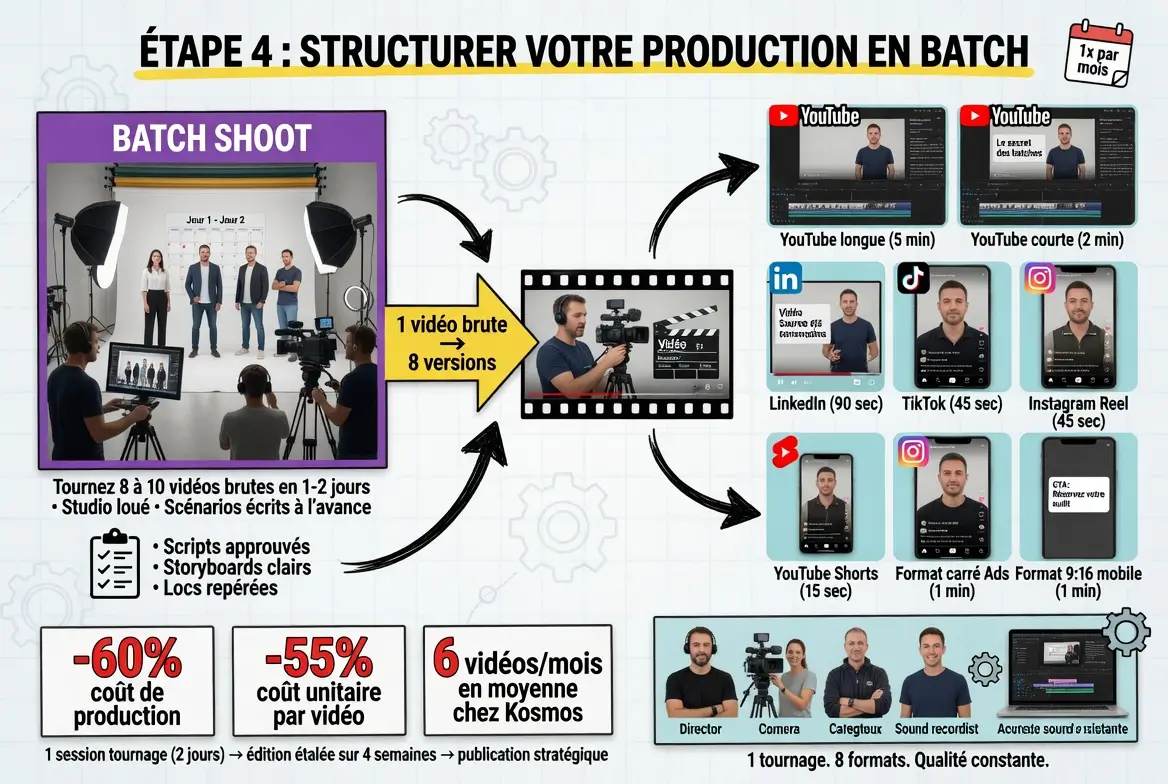
A video marketing strategy that produces 16 videos per month can't shoot one video, edit it, publish it, and then shoot the next one. It's time consuming and expensive. You use batch production: shoot 4 videos in a day or two, spread the editing and publishing over the month. This reduces your production cost by 60% and accelerates your marketing.
Concretely: you plan a batch shoot once a month. You rent a studio or a place for two days, you shoot 8 to 10 raw videos. Each video is a specific scenario, written in advance. Then, your editing team unfolds these raw videos into 8 versions each throughout the month. A source video becomes: 1 long YouTube version (5 min), 1 short YouTube version (2 min), 1 LinkedIn version (90 sec), 1 TikTok (45 sec), 1 Instagram Reel (45 sec), 1 YouTube Shorts (15 sec), 1 YouTube Shorts (15 sec), 1 square format for Ads (1 min), 1 format 9:16 mobile (1 min). It's 8 videos delivered from a single shoot.
This model saves time and budget. Kosmos produces an average of 6 videos per month for its customers using this batch system: a shooting session (2 days), then editing spread over 4 weeks, then strategic publication. The unit cost per video falls by 55% compared to video shooting per video, and the quality remains constant.
- Batch shoot: Shoot 4 to 10 videos in 1 to 2 days, once a month
- Edition variations: 1 raw video becomes 8 versions for all channels
- Savings: -55% of the unit video cost with batch production vs isolated shooting
- Pre-production: scripts approved before the shoot, clear storyboards, locs identified
- Shooting crew: Real, cam, sound, assistant, to ensure consistent quality
Step 5: Define your smart distribution by channel
Producing a video without a distribution strategy means publishing it everywhere at random. Distributing intelligently means: each video first goes to the channel where it converts best, then it goes to the other channels. A customer testimonial first goes to your site (where it helps to convert live), then to YouTube (where it accumulates SEO and traffic), then to LinkedIn (where your B2B audience will share it), then to TikTok (less relevant but possible).
On YouTube, always post on Tuesday or Wednesday, 10 am. YouTube is enriching the videos on Tuesdays and promoting them in the recommendations starting on Wednesday. Well-optimized YouTube content (title, description, tags, keywords in the first 100 characters) generates traffic for 2 to 3 years. It is your long-term investment. Aim for 100 videos on YouTube in two years: this is the threshold where the algorithm starts to consider you a valid content creator and automatically suggests you.
On TikTok and Instagram Reels, post at night (6 p.m. to 10 p.m.) when people scroll before bed. Post 5 to 7 times a week on these channels: frequency creates the algorithm. If you post 1 video per week, TikTok sees you as an inactive creator. If you post 5 per week, you activate the algorithm. Reuse your 45-second clips, post the same video 2 to 3 times with different hashtags.
On LinkedIn, post on Tuesday, Wednesday, or Thursday between 10 am and 2 pm. It's when your B2B audience is working and scrolling through the feed. Alternate: once the video is native (directly posted on LinkedIn), once as a LinkedIn article with a link to the full video on YouTube. This changes the format and relaunches the engagement.
- YouTube: public on Tuesday/Wednesday, 10 am, aim for 100 videos in 2 years, long-term SEO investment
- TikTok/reels: 5-7 times a week in the evening (18h-22h), reuse the same video 2-3 times a week in the evening (18h-22h), reuse the same video 2-3 times, different hashtags
- LinkedIn: Tuesday/Wednesday/Thursday 10am-2pm, alternate native video and LinkedIn article
- Website: video in hero section or in the conversion funnel, optimized for the CTA
- E-Mail: link to the YouTube video in nurturing emails, opening rate +35% if video
Step 6: measure the real impact with the right KPIs
A video marketing strategy without measurement is blind marketing. You need to track four levels of KPI: engagement (does it work with the audience?) , conversion (do videos generate leads?) , the ROI (is it profitable in money?) and attribution (which video caused which sale?).
Engagement: views, average viewing time, retention rate (% of video watched). A good retention rate is 50%: half of people watch until the end. If yours is 20%, the problem is in the first minute. Optimize your openness. On YouTube, over 60% retention is excellent. CTA clicks: each link in the video must be drawn with a specific UTM (utm_source=video, utm_medium=youtube, utm_campaign=awareness_mars). Shares: if your video generates few shares, it mostly speaks to your immediate audience, not beyond.
Conversion: clicks to your site, form submissions, chats initiated via Drift or Intercom. This is the moment when a video on your site takes a lead to the next stage of the funnel. The ideal conversion rate depends on your industry, but 2 to 5% of your video viewers who click the CTA is a good benchmark. Leads generated: via the form (email collected), direct phone calls after watching the video, chat conversations. Each lead must be tagged “origin = video” in your CRM.
ROI: video production cost (shooting, editing, combinations) divided by the income generated by the leads/sales from this video. A 2000 euro video that generates 10 customers of 500 euros each = 5000 euros in revenue = 2.5x ROI. Ideal: 5x ROI in 6 months for a Conversion video, 3x ROI in 12 months for a video Consideration (slower performance). Attribution: what part of the customer was influenced by the video? Use Google Analytics 4 with data-driven attribution: it will credit your videos with the correct weight in multi-channel conversion.
- Commitment: views, average duration, retention rate (target 50% + YouTube), CTA clicks
- Conversion: leads generated, conversion rate (target 2-5%), cost per lead
- KING: revenue generated/production cost, target 3x to 5x in 6 months for Conversion
- Attribution: What part of the customer comes from which video? Google Analytics 4 Data-Driven Attribution
- Monthly dashboard: summary of the 10 videos of the month, KPIs, and adjustment recommendations
Step 7: Optimize your strategy gradually
A video marketing strategy is alive. You don't plan the year and then execute without changing anything. You adjust every month based on the data. If you notice that your YouTube videos are stuck at 500 views, the problem is in your title, description, or blackboard (thumbnail). Test 3 different titles, 3 different thumbnails, until you find the one that clicks.
If your retention rate on TikTok is 15%, but on YouTube 55%, it means that TikTok is not suitable for your type of content. Focus on YouTube. Reallocate your TikTok budget to YouTube and LinkedIn where it works. This “data-driven” discipline is gradually giving rise to an optimized video conversion machine. After 3 to 6 months, you know exactly what video length works for you, what type of topic, what CTA converts, what channel brings the best leads.
Benchmark your rivals as well: what types of videos do they publish? What is their frequency? What channels are they investing heavily? If you are in a market where your 3 major competitors post 5 videos per week on YouTube and you post 1 per month, you are very far behind. Kosmos conducted quarterly video audits of its customers' competitive strategy: this shows where you are falling behind and where you are gaining ground.
- Monthly optimization: analyze the data, adjust the titles, thumbnails, publication times
- A/B testing: 3 thumbnail formats, 3 titles, compare clicks and views
- Budget reallocation: If a channel doesn't convert, move the budget to a channel that works
- Competitive audit: How many videos are your rivals publishing? On which channels? What type?
- Continuous improvement: after 6 months, you have a mature and optimized video conversion machine
Integrating video into your overall marketing mix
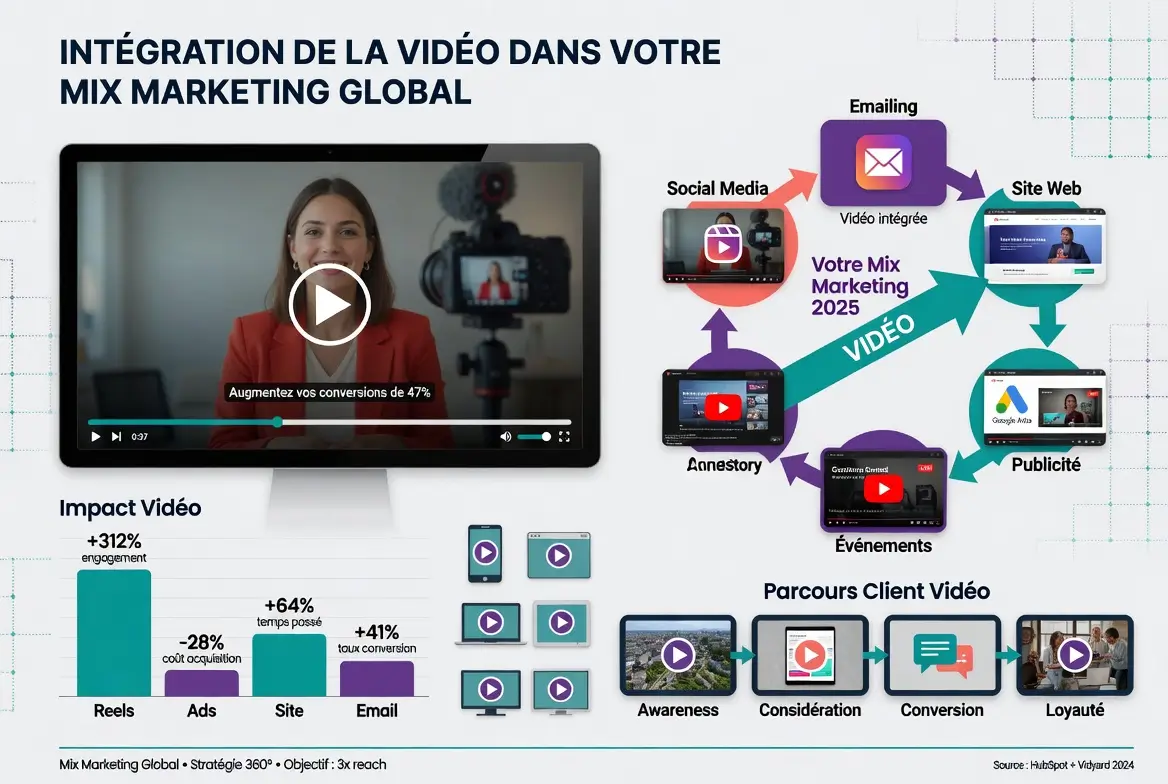
A video marketing strategy does not exist alone. It fits into your overall mix: text SEO (blog), email, social networks, paid ads, LinkedIn content. How does video complement these channels?
Text blog + YouTube video: publish a 2500-word article on a key topic (e.g., “How do I choose a SaaS provider?”). At the end, embed a 5-minute YouTube video that summarizes the article. Google sees this text + video combination as rich and powerful content. Your SEO ranking is increasing. Email + video: an email nurturing campaign earns 35% more clicks if you insert a link to a YouTube video (vs. a link to a text-only article). LinkedIn feed + video: alternate long text articles and national videos. Videos get 10x more engagement than text on LinkedIn. Paid ads + video: a video ad on YouTube Ads or Facebook costs 40% less per lead than a display text ad.
Think cross-channel. A video produced for YouTube can be reused in email, LinkedIn content, snippets for Stories, and webinar materials. Maximize the use of each video produced.
- Blog + YouTube video: in-depth article, summary video, mutually boost SEO
- Email + video: +35% more clicks if a link to a YouTube video rather than text content
- LinkedIn + video: 10x more video vs text engagement on LinkedIn
- Ads + video: cost per lead -40% with video ads vs text displays
- Cross-channel reuse: 1 YouTube video = 8 versions for different channels and formats
Common missteps that sabotage your video marketing strategy
A video marketing strategy can fail for simple reasons that are often overlooked. First, the bad audio. 80% of the videos that are abandoned are abandoned because of the bad sound, even before the image. Invest in a good mic, always. Second error: no clear call to action. Is your video great but doesn't have a CTA? Nobody knows what to do next. “Click the link in the bio”, “Contact us for a quote”, “Subscribe”, insert a visible CTA.
The third pitfall: one video for all channels. You produce an 8-minute video and post it on TikTok hoping for virality. It's not working. Each channel has its own expectations in terms of length and format. TikTok wants 45 sec max, YouTube wants 4 to 8 min, LinkedIn wants 1 to 3 min. Produce combinations with thought as soon as you shoot. Fourth mistake: ignoring your analytics. You're posting videos without looking at the data. What content works? What content doesn't work? You need to know. Finally, confusing views with conversion. A video with 100,000 views but 0 conversions is worth nothing commercially. A video with 5,000 views but 50 qualified leads generated is worth much more.
- Bad audio: Cause 80% of video dropouts, invest in a good lavalier microphone
- No CTA: video that's beautiful but doesn't convert, always add a clear call to action
- A video for all channels: TikTok wants 45s, YouTube wants 5 min, declines depending on the channel
- Skip analytics: You need to know which video is working and why
- Confusing views and conversion: 100k views without leads = zero commercial value
Take action: launch your video marketing strategy in 30 days
A video marketing strategy is never perfect at the start. It becomes excellent after 3 months of execution and optimization. Here is the action plan for the next 30 days. Week 1: define your 3 priority goals (Awareness, Consideration, Conversion?). What is the major business objective? Week 2: Set up your annual production schedule. How many videos per month can you produce without overloading yourself? Week 3: start your first batch production. Shoot 4 videos. Week 4: edit the 4 videos in 8 variations, publish on all your channels.
After these first 4 weeks, you have a system up and running. A month later, you measure: which video generated the most views? Which CTA has the best click-through rate? What channel works best? You are adjusting. Three months later, your video strategy is optimized and generates real business.
Kosmos helps its customers to implement this complete cycle in 90 days: initial diagnosis (1 week), strategic definition (1 week), production and combinations (8 weeks), optimization (2 weeks). In the end, you have 30+ videos produced, distributed, and optimized for conversion. More importantly, you have a monthly video production system that continues to generate visibility and leads long after.
Discover how to boost your ROI with video. Do you want to integrate micro-content? Read our guide On snack content in social media strategy. And if you hesitate between UGC and pro video, Check out our UGC vs video pro analysis. Finally, explore our complete video agency guide to dive deeper into all aspects of professional video production.
Video marketing in 2026 is no longer optional. It is the channel that generates the most conversions and the most customer loyalty. A structured video marketing strategy multiplies your business by 2 to 3. The rest is execution.
FAQ: your questions about video marketing strategy
How much does a comprehensive video marketing strategy cost?
A video marketing strategy is first of all free if you develop it yourself (internal audit, planning). If you use an agency like Kosmos for audit and strategic definition, count 2,000 to 5,000 euros for 30 days of consultation. Then comes the production: 2000 to 4000 euros per video on average. A complete calendar of 12 videos per year varies from 24,000 to 48,000 euros including production. More mature businesses allocate 10% of their marketing budget to video, which can represent 50,000 to 200,000 euros annually.
How long until you see ROI on video marketing?
Conversion videos (testimonials, product demos) start generating leads in 4 to 8 weeks so well placed and distributed. You should see a positive ROI (revenue generated greater than the cost of production) after 3 to 6 months with a regular schedule of 4 to 8 monthly videos. Awareness videos take 6 to 12 months before showing ROI because they accumulate views gradually. YouTube generates traffic for 2 to 3 years after publication, so the ROI extends over time.
Should video production be outsourced or done in-house?
Outsourcing to an agency like Kosmos offers expertise, consistent quality, and rapid production capacity. Internally, you gain flexibility and reduced fixed costs but you limit capacity (hard to produce 10+ videos per month internally without a dedicated team). A hybrid model works well: agency for strategy, complex shootings, and premium editing; you in-house for simple content (webcam, light interviews, reuse). Ideal: 70% agency, 30% internal.
What is the ideal length for a marketing video?
It depends on the channel and the objective. TikTok/reels: 15 to 60 seconds max. YouTube: 4 to 8 minutes to maintain engagement LinkedIn: 1 to 3 minutes. Website landing page: 60 to 90 seconds. Tutorials/consideration: 5 to 10 minutes. Shorter is not always better: a video that is too short says nothing, a video that is too long loses the viewer. Test and measure retention rates.
How do I really measure the impact of a video on my sales?
Three methods. One: tag each video with a specific UTM (utm_source=video_youtube_mars) and follow the leads/sales from this UTM in your CRM. Two: Google Analytics 4 with data-driven attribution sees how much of the conversion comes from each video. Three: ask your new customers “how did you find out about us?” and tag “YouTube video” or “Reels video” in the CRM. The intersection of these three methods shows you the real impact.
Do I need to produce a completely different video for each channel?
No A source video comes in 8 versions: long YouTube, 3min, 2min, 3min, 3min, 2min, 90sec, 45sec, 15sec, square (1:1), and 9:16 (mobile). Each variation is a different assembly of the same raw material, adapted to the channel and its audience. It's more efficient than shooting a completely different video per channel. You save budget and maintain message consistency.
Conclusion: Your Video Marketing Strategy Starts Now
Video marketing in 2026 is strategic or it does not exist. A video without a shot doesn't convert much. A well-thought-out video, integrated into a year-long strategy, broadcast intelligently, rigorously measured, generates sustainable business. A company with 12 optimized videos per year generates 5x more leads than a company that produces 2 without a strategy.
Contact Kosmos to start a video marketing strategy that converts. We conduct a free audit of your current situation, offer a 90-day action plan, and then execute it to generate measurable results. Your competitors are producing video. Make video that sells.